Phonons and scaling
Most DFT codes output phonon eigenvectors which represent displacement multiplied by the square root of the mass of each atom. This odd-seeming choice arises naturally from the maths used to solve for the phonons, and it means that the eigenvectors are orthogonal.
Given that all atoms in a given mode vibrate with the same frequency, their maximum velocity is proportional to their displacement, and therefore their maximum kinetic energy is proportional to their mass multiplied by the square of their maximum displacement. This is the square of the components in the eigenvector.
But it can be useful to remove the √m factor in order to see the true displacements (or perhaps to retain it in order to reduce the length of the arrows on hydrogen atoms). Below an example considering mode 7 of a water molecule. Water will have three translational modes, three rotational modes, and then three vibrational modes to make the total nine (the total must be three times the number of atoms). This bond-bending mode is the lowest frequency vibrational mode. Minimum version of c2x is 2.50a.
$ c2x --ph2force=7 water.phonon water.xsf
$ tail -3 water.xsf
1   5.3230700   5.0000000   4.2319900  -0.5444971  -0.0000000  -0.4080023
1   5.3230700   5.0000000   5.7680100  -0.5444971   0.0000000   0.4080023
8   4.7331600   5.0000000   5.0000000   0.2722388   0.0000000  -0.0000000
$ xcrysden --xsf water.xsf
Display | Forces
Modify | Force Settings | Length Factor | 1
Modify | Ball Factor | 0.1
Top left coloured box | white
Zoom and rotate
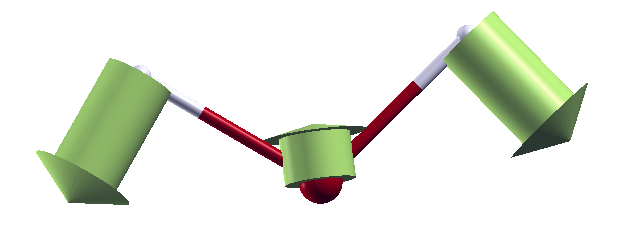
It is clear that the eigenvector in the xsf file would not conserve momentum if considered to represent velocity. In the x direction we have two hydrogens, mass one, with a value of -0.54, and one oxygen, mass sixteen, with a value of 0.27. If we add a "d" (displacement) flag to c2x, then the vector will be rescaled to represent displacement (or velocity).
$ c2x --ph2force=7:d  water.phonon water.xsf
$ tail -3 water.xsf
1   5.3230700   5.0000000   4.2319900  -0.5644488  -0.0000000  -0.4229525
1   5.3230700   5.0000000   5.7680100  -0.5644488   0.0000000   0.4229525
8   4.7331600   5.0000000   5.0000000   0.0708344   0.0000000  -0.0000000
2*1*(-0.564)+1*16*0.07=0 (approximately), so zero momentum.
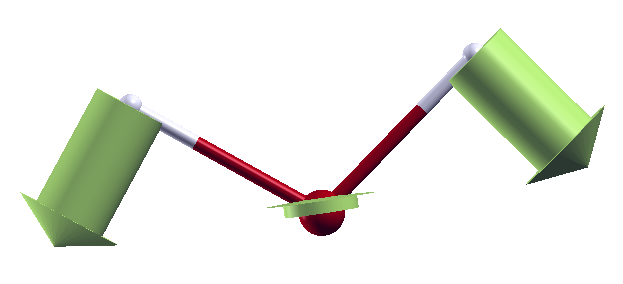
The arrow on the oxygen is now much smaller than that on the hydrogens. The length of each hydrogen arrow, even after projection onto the direction of the oxygen arrow, should be eight times as long as the oxygen arrow. The extra component perpendicular to the direction of motion of the oxygen gives a total length ratio of almost 1:10.