Silicon Band Structure with Quantum Espresso
This example shows the calculation of silicon's bandstructure with Quantum Espresso.
Unlike CASTEP, QE requires two runs, the first to form the self-consistent density, and the second to calculate the band structure.
Self-consistent calculation
The input files for the self-consistent calculation are the same as for the density of states calculation.
&CONTROL
  calculation = 'scf',
  outdir = '.'
  pseudo_dir = '.'
/

&SYSTEM
  ibrav =  2,
  celldm(1) = 10.2076,
  nat =  2,
  ntyp = 1,
  ecutwfc = 50,
  nbnd = 8
/

&ELECTRONS
/

ATOMIC_SPECIES
  Si 28.086 Si.UPF

ATOMIC_POSITIONS (alat)
  Si 0.0 0.0 0.0
  Si 0.25 0.25 0.25

K_POINTS (automatic)
  6 6 6 0 0 0
And, for the pseudopotential
$ curl -o Si.UPF https://pseudopotentials.quantum-espresso.org/upf_files/Si.pz-vbc.UPF
Then PWSCF can be run to perform the self-consistent step with:
$ pw.x < si1.in > si1.out
Non self-consistent calculation
The next run will use the output files from the above calculation, particularly the calculated charge density which will form part of the fixed potential. The differences in the input file are shown below.
&CONTROL
  calculation = 'bands',
  outdir = '.'
  pseudo_dir = '.'
/

    [...]

K_POINTS {crystal_b}
6
 0.5     0.25     0.75     9  ! W
 0.5     0.5      0.5     11  ! L
 0       0        0       12  ! Gamma
 0.5     0        0.5      6  ! X
 0.5     0.25     0.75     5  ! W
 0.375   0.375    0.75     0  ! K
And this can be run as
$ pw.x < si2.in > si2.out
and will over-write the pwscf.xml file produced by
the first run.
Band Structure
The results can be analysed in the same way as the Castep band structure.
$ c2x --bands_gnu --title="Si (QE)" pwscf.xml Si.gnu
$ gnuplot -p Si.gnu
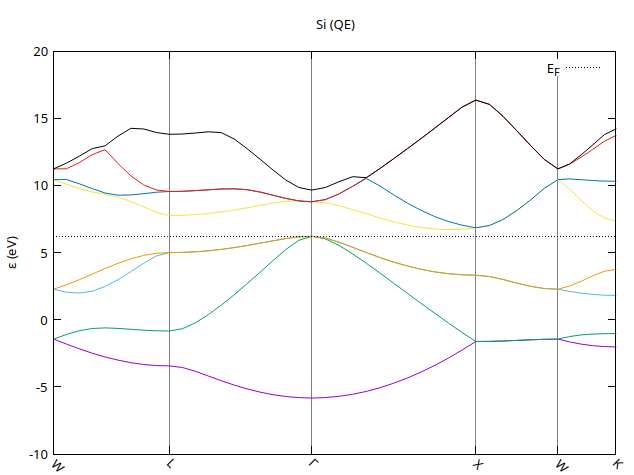
Note that QE defaulted to calculating fewer empty bands.