Phonon Band Structure with Castep
Castep provides two methods for calculating phonons along a path. One can either do an SCF calculation, and then a phonon calculation at each point on the path, or one can do a phonon calculation at each point on a regular grid, and use Fourier interpolation to obtain the eigenvalues and eigenvectors on the path. The interpolation is very quick, so in terms of time the faster method will be the one needing fewer q points.
For a calculation on diamond, the cell file might start
%block LATTICE_ABC
 2.5357 2.5357 2.5357
 60.0000000  60.0000000  60.0000000
%endblock LATTICE_ABC

%block POSITIONS_FRAC
 C  0.000000000  0.000000000  0.000000000
 C  0.250000000  0.250000000  0.250000000
%endblock POSITIONS_FRAC

%block species_pot
NCP
%endblock species_pot

symmetry_generate

kpoint_mp_grid 8 8 8
kpoint_mp_offset include_gamma
and the param file would contain
task             : PHONON
phonon_sum_rule  : TRUE
(If the system is insulating, and the atoms are not all identical,
fix_occupancy : TRUE
must be added in order to calculate LO-TO splitting correctly.
For the conventional approach, the cell file would also need a block reading
%block phonon_kpoint_path
0.0 0.0  0.0     ! Gamma
0.5 0.0 0.5      ! X
0.375 0.375 0.75 ! K
0.0 0.0  0.0     ! Gamma
0.5 0.5 0.5      ! L
0.5 0.25 0.75    ! W
0.5 0.0 0.5      ! X
%endblock phonon_kpoint_path
whereas for the interpolated approach it needs something like
phonon_kpoint_mp_grid 8 8 8
phonon_kpoint_mp_offset include_gamma

%block phonon_fine_kpoint_path
0.0 0.0  0.0     ! Gamma
0.5 0.0 0.5      ! X
0.375 0.375 0.75 ! K
0.0 0.0  0.0     ! Gamma
0.5 0.5 0.5      ! L
0.5 0.25 0.75    ! W
0.5 0.0 0.5      ! X
%endblock phonon_fine_kpoint_path
with the addition of
phonon_fine_method : INTERPOLATE
in the param file.
With these choices, symmetry results in the interpolating method
needing to calculate at 29 q-points (the 8x8x8 grid, symmetrised),
but the number of points on the path is 90. The interpolating method
was indeed over three times faster. The final output file,
the .phonon file, gives no hint as to which method was
used.
The other big advantage of interpolation is that if one has already done the DoS calculation with interpolation, for this calculation one can add
continuation : diamond.check
to the param file, and the calculation will run in a few seconds, taking data from the check file.
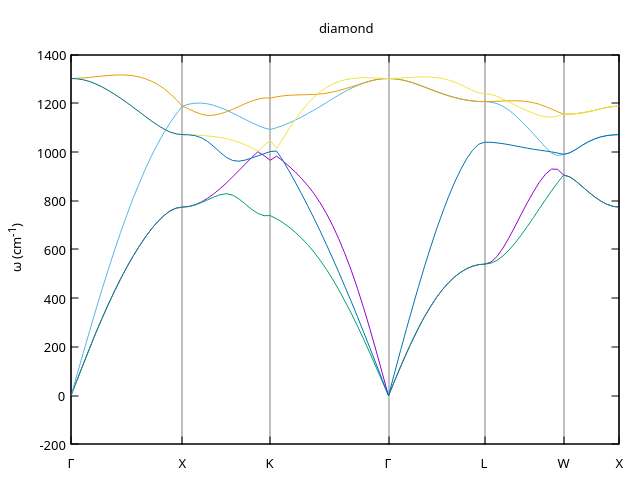
Plotting with dispersion.pl
Castep provides a perl script for plotting band structures.
$ dispersion.pl -gp -symmetry fcc diamond.phonon
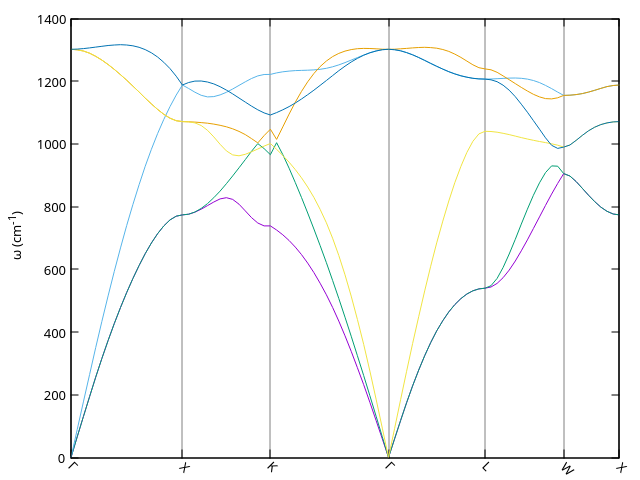
Plotting with c2x
$ c2x --phbands_gnu_dcross diamond.phonon out.gnu
Comparison
There is little to choose between c2x and dispersion.pl. C2x
auto-detects the symmetry, but dispersion.pl needs it to be
specified. C2x defaults to doing nothing to detect band crossings,
but adding _dcross enables an algorithm similar to, but
not identical to, that used by dispersion.pl. Dispersion.pl defaults
to resolving crossings, but this can be disabled
with -nj.
C2x will output to Gnuplot or EPS, and dispersion.pl to Gnuplot or
XMGrace. Dispersion.pl knows more units. Both default to
cm-1, and c2x additionally offers just THz
(add _THz to the phbands string) and meV
(add _meV).