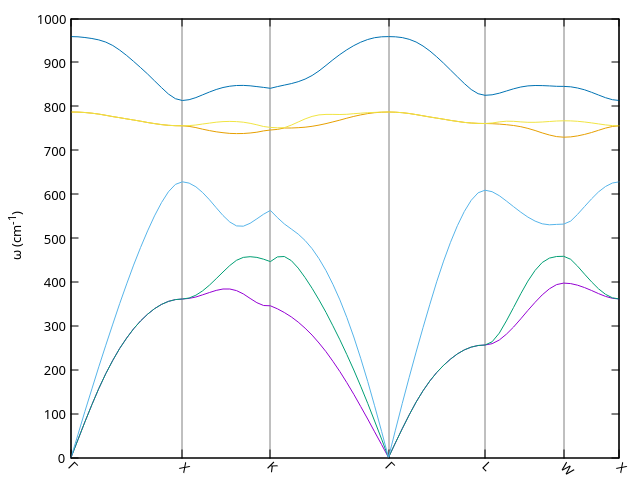
Abinit does not perform LO-TO splitting automatically, and it may be sensible to perform these calculations via abipy. However, if, for some reason, one wishes to use a more direct route, see below.
SiC.abi SiC_2.abi SiC_3.abi SiC_4.abi SiC_5.abi SiC_5.files
The pseudopotentials used were from
the Psdj_nc_sr_04_pbe_std_psp8 directory from the
distribution.
The method follows that for the diamond bandstructure with Abinit, including the need to rename four files between the first and the second steps.
The difference is at the end of SiC_4.abi.
! Wavevector list number 2 (Cartesian directions for non-analytic gamma phonons)
  nph2l    1       ! number of directions in list 2
  qph2l   1.0 0.0 0.0    0.0
For a cubic system such as this all directions are equivalent, so
one can pick any. But this section causes anaddb to perform a non-analytic
calculation at the Γ point, and this gets tacked on to the end of the
corresponding .abo file.
 Treat the second list of vectors

  Phonon at Gamma, with non-analyticity in the
  direction (cartesian coordinates)  1.00000  0.00000  0.00000
 Phonon energies in Hartree :
   0.000000E+00  0.000000E+00  0.000000E+00  3.585534E-03  3.585534E-03
   4.368641E-03
 Phonon frequencies in cm-1    :
-  0.000000E+00  0.000000E+00  0.000000E+00  7.869337E+02  7.869337E+02
-  9.588059E+02
The result is rather disappointing.
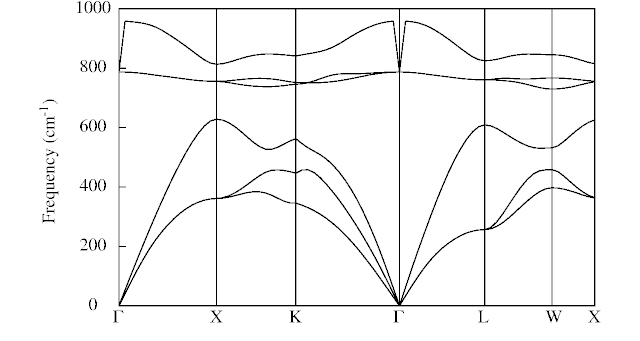
A difference in the way in which Abinit interpolates compared to Castep means that the error is confined to the Γ point, and thus the plot looks obviously unphysical.
The frequencies with the LO-TO splitting corrected are found in the
SiC_4.abo, SiC_4o_anaddb.nc
and SiC_4o_PHBST.nc files, but are not in
the SiC_4o_B2EPS.freq, SiC_4o_PHFRQ
or SiC_4o_PHBANDS.agr files. Even in those files in
which they do occur, the frequencies are first given without the
LO-TO splitting, and then there is an appendix containing the
splitting which one somehow needs to patch in at the correct
place(s).
In this simple example, there are no band crossings, so there is no
need to consider the eigenvectors. C2x can read
the SiC_4.abo output and produce a band structure with
the patching performed.
$ c2x --phbands_gnu SiC_4.abo out.gnu
$ gnuplot -p out.gnu