Diamond Phonon DoS using QE
Just like Castep, QE can calculate phonons on a set of q points, interpolate onto a denser set (the "fine grid"), and calculate the DoS directly itself. There is little for any post-processing tool to do. However, the calculation does seem more difficult to set up than for Castep. This uses the same 8x8x8 initial grid, with interpolation to 18x18x18, that the Castep calculation used.
SCF calculation
diamond.in
&CONTROL
  calculation = 'scf',
  outdir = '.',
  pseudo_dir = '.'
/
&SYSTEM
  ibrav = 0,
  nat   = 2,
  ntyp  = 1,
  ecutwfc = 40
/
&ELECTRONS
/

CELL_PARAMETERS angstrom
  2.5357000   0.0000000   0.0000000
  1.2678500   2.1959806   0.0000000
  1.2678500   0.7319935   2.0703904

ATOMIC_SPECIES
  C    1.0   C.UPF

ATOMIC_POSITIONS angstrom
  C   0.000000000  0.000000000  0.000000000
  C   1.267850000  0.731993539  0.517597595

K_POINTS automatic
  8 8 8 0 0 0
The pseudopotential used was C.UPF and the calculation runs in a few seconds as
$ pw.x < diamond.in > diamond.out
Phonon calculations need well-relaxed geometries. Here symmetry makes
things simple. If a DFT relaxation step is needed, then set
calculation = 'relax',
and include an empty ions card
&IONS
/
Phonons
The next calculation actually calculates the phonons on the coarse phonon grid, slowly.
diamond.ph.in
Normal modes for diamond
 &inputph
  amass(1)=12
  epsil=.true.,
  trans=.true.,
  asr=.true.,
  ldisp=.true.,
  nq1=8,
  nq2=8,
  nq3=8,
  fildyn='dmat.diamond'
 /
$ ph.x < diamond.ph.in > diamond.ph.out
That run may take a core-hour, and will produce 65 output files.
Dynamical matrix
The above output then needs to be processed and combined by q2r.
diamond.q2r.in
&INPUT
  fildyn="dmat.diamond",
  zasr="crystal",
  flfrc="flfrc.diamond"
/
At least this step runs very quickly.
$ q2r.x < diamond.q2r.in > diamond.q2r.out
DoS and Eigenvalues
The final calculation of the DoS and eigenstates on a fine grid is performed by matdyn.x.
diamond.matdyn.in
&INPUT
  flfrc="flfrc.diamond",
  asr="crystal",
  dos=.true.,
  nk1=18,
  nk2=18,
  nk3=18
/
which runs in a few tens of seconds
$ matdyn.x < diamond.matdyn.in > diamond.matdyn.out
This produces a matdyn.dos file which can be plotted directly.
gnuplot> plot "matdyn.dos" using 1:2 w l
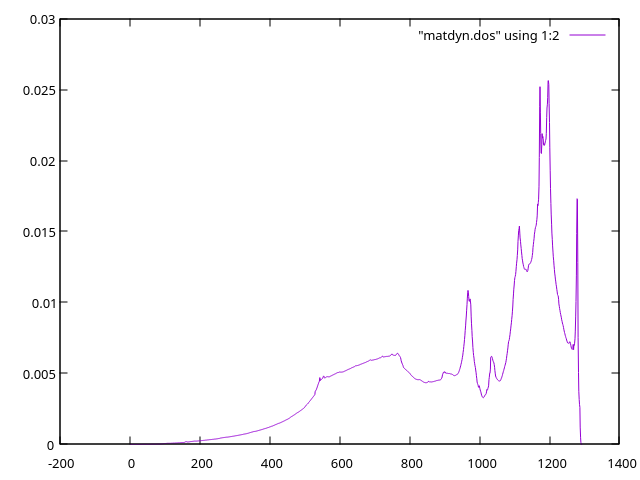
QE had used Blöchl's tetrahedral method, and
the .dos file also contains the DoS projected onto each
atom separately (very uninteresting in this case where the atoms are
equivalent under symmetry operations).
QE also produces a matdyn.freq file, which contains
kpoints, weights and frequencies. It does not contain any information
about the unit cell, and the kpoints are after symmetrisation and in
Cartesian co-ordinates.
If you really want to process it with c2x, then
$ c2x --merge --phdos_gnu diamond.in matdyn.freq out.gnu