Ethene's ELF with Quantum Espresso
Unusually for an example on this website, this calculation makes no use of c2x at all.
Firstly QE is run in a manner almost identical to that on the QE ethene orbitals page.
$ curl -o https://www.c2x.org.uk/elf/ethene.in
$ curl -o C.UPF.gz http://www.pseudo-dojo.org/pseudos/nc-sr-05_pbe_standard/C.upf.gz?download
$ gunzip C.UPF.gz
$ curl -o H.UPF.gz https://www.pseudo-dojo.org/pseudos/nc-sr-05_pbe_standard/H.upf.gz?download
$ gunzip H.UPF.gz
$ pw.x -in ethene.in > ethene.log
There are two differences between this and the orbitals calculation. The cut-off has been raised from 35Ry to 55Ry, and non-ultrasoft pseudopotentials from Pseudo Dojo are used, as QE 7.3 warns that it cannot do ELF calculations correctly with US potentials.
Then one can use the QE post-processing tool PP to calculate the ELF. The input file required is
&INPUTPP
  plot_num = 8
/
&PLOT
  iflag = 3,
  output_format = 5,
  fileout = 'elf.xsf'
/
and this can be run as
$ pp.x -in pp.in
This then produces an XSF file directly. See also PP's documentation.
The version of pp.x I used has a bug, in that the atomic symbol is omitted for the hydrogens in the coordinate section.
 PRIMCOORD
           6           1
C         4.698560000    4.000000000    3.500000000
C         3.301440000    4.000000000    3.500000000
          5.270880000    4.923920000    3.500000000
          2.729120000    3.076080000    3.500000000
          2.729120000    4.923920000    3.500000000
          5.270880000    3.076080000    3.500000000
After adding an H to the start of each of the last four lines above one can run Xcrysden.
The result is a little disappointing.
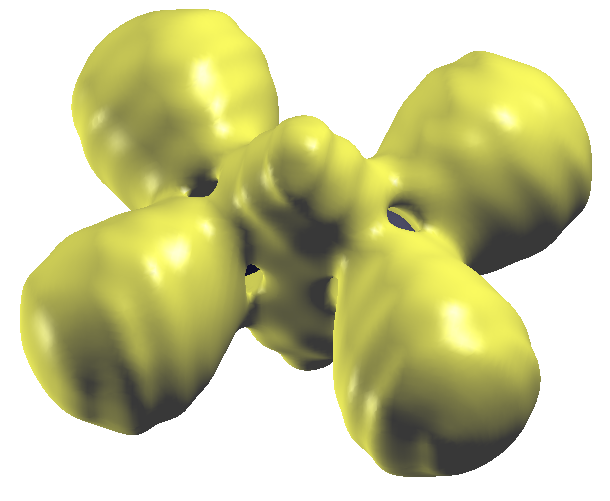
My attempts to produce a result which looks qualitatively similar to the Abinit, Castep and VASP results have so far failed. I would conclude that QE (7.3) is wrong.
Wrong?
"Wrong" may be too strong a word. There are many definitions of the Electron Localisation Function.
- Becke and Edgecombe, J. Chem. Phys. 92 5397 (1990)
- Savin et al. Ange. Chemie Intl. Ed. 31 187 (1992)
- Kohout and Savin, Intl J. Quantum Chemistry 60 875 (1996)
- Javis and Carter, J. Phys. Chem. B 105 4045 (2001)
I believe that Quantum Espresso uses Becke and Edgecombe, whereas everything else uses one of the later expressions, as Becke and Edgecombe used Hartree-Fock theory, and the later versions use LDA.