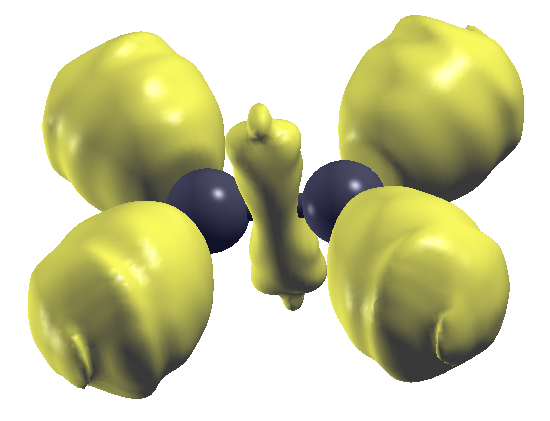
Ethene's ELF with Abinit
Although c2x 2.41c or later is needed for the automatic detection of ELF files from Abinit, it is quite simple to analyse them with much earlier versions of c2x, for the structure of an Abinit ELF output file is identical to that of a density file.
Calculation
ethene.inSuitable pseudopotentials can be obtained with
$ curl -O http://www.pseudo-dojo.org/pseudos/nc-sr-04_pbe_standard/C.psp8.gz
$ gunzip C.psp8.gz
$ curl -O http://www.pseudo-dojo.org/pseudos/nc-sr-04_pbe_standard/H.psp8.gz
$ gunzip H.psp8.gz
Then Abinit can be run as
$ abinit ethene.in
c2x processing
If using an old version of c2x, then
$ ln -s etheneo_ELF elf_DEN
$ c2x -c -R --xsf elf_DEN ethene.xsf
or if using 2.41c or later, simply
$ c2x --xsf etheneo_ELF ethene.xsf
In the first case -c is necessary to make c2x read the
"density" from this output file, else it will assume that just the
co-ordinates were wanted. Then -R emits the raw data,
without any attempt to rescale the "density" from e/Bohr3
to e/A3. An ELF is a dimensionless quantity which does not
need rescaling.
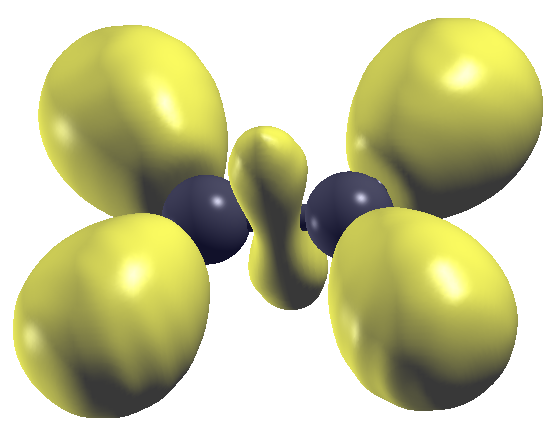
Broadly similar to the result from Castep.
Note that if a lower cut-off is used, for instance 550eV, as was used for the orbitals example, the result can look quite different, as is seen below. A cut-off which is adquate for calculating one parameter may not be sufficient for another.