Brillouin Zones and VMD
C2x from 2.41 has some support for finding First Brillouin Zones and Irreducible BZs. This page demonstrates the functionality with VMD. An almost identical page exists for doing the same with Jmol.
An FCC cell
The following examples use a cell file, called fcc.cell, of
%block LATTICE_CART
1 1 0
0 1 1
1 0 1
%endblock LATTICE_CART
The simplest use is
$ c2x --vmd_recip --fbz fcc.cell fcc.vmd
One can then launch VMD, choose Extensions, Tk Console, and type
% source "fcc.vmd"
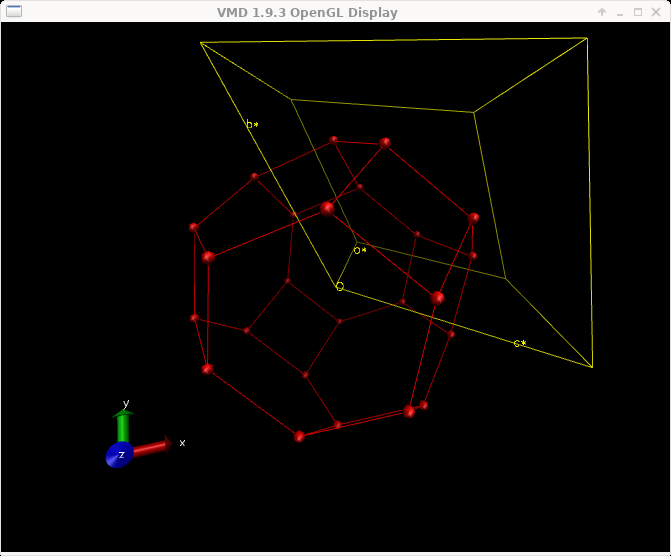
The yellow cell is the reciprocal space unit cell, and the red cell
the first Brillouin zone, as requested by --fbz. VMD's
output can be zoomed with the mouse wheel, and rotated by dragging
the mouse. The degree of perspective distortion which VMD uses to
show depth is sometimes surprising, but in the "VMD Main" window one
can select "Display | Orthographic" to turn it off.
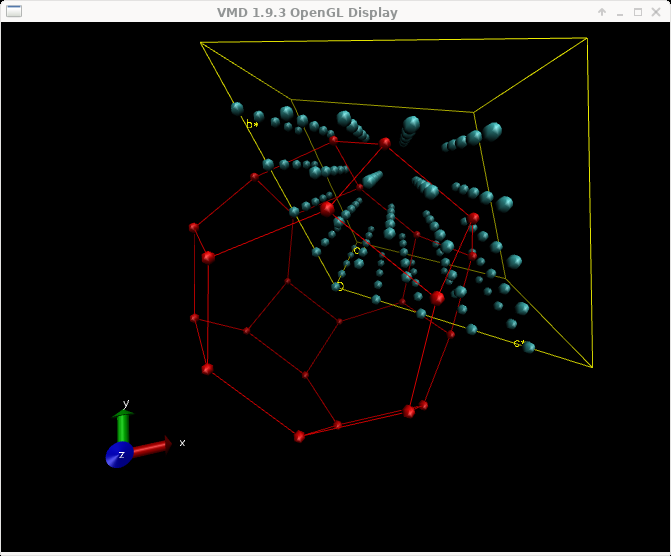
If k-points are present in the input, they will be shown in the output. Rather than add them to the input file, here we ask c2x to generate a 5x5x5 grid and to include points related by inversion.
$ c2x --vmd_recip -M=5,5,5 --nokinv --fbz fcc.cell fcc.vmd
In VMD we can type
  % molecule delete all
  % source "fcc.vmd"
It is also possible to reduce k-points to the Brillouin zone.
$ c2x --vmd_recip -M=5,5,5 --nokinv --fbz -r fcc.cell fcc.vmd

This option will also work with other formats listing k-points. So
$ c2x --fbz -r --cell a.cell b.cell
should move any k-points in the input to the first Brillouin zone in the output.
Irreducible Brillouin Zone
The Irreducible Brillouin Zone can be calculated following the method of Jorgensen et al.. Symmetry operations are required, so must be calculated if not already present in the input.
$ c2x --ibz --sym --vmd_recip fcc.cell fcc.vmd
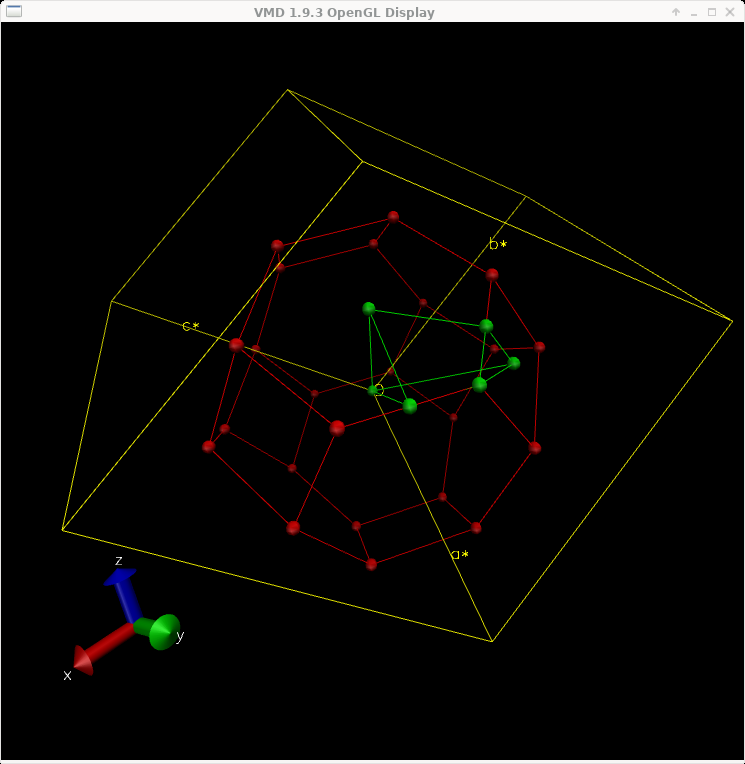
The irreducible zone is shown in green. Note that is is not unique. It exists in as many orientations as there are symmetry operations, and, in some cases, different choices of IBZ also exist. C2x makes an attempt to produce a consistent orientation with respect to the reciprocal lattice vectors.
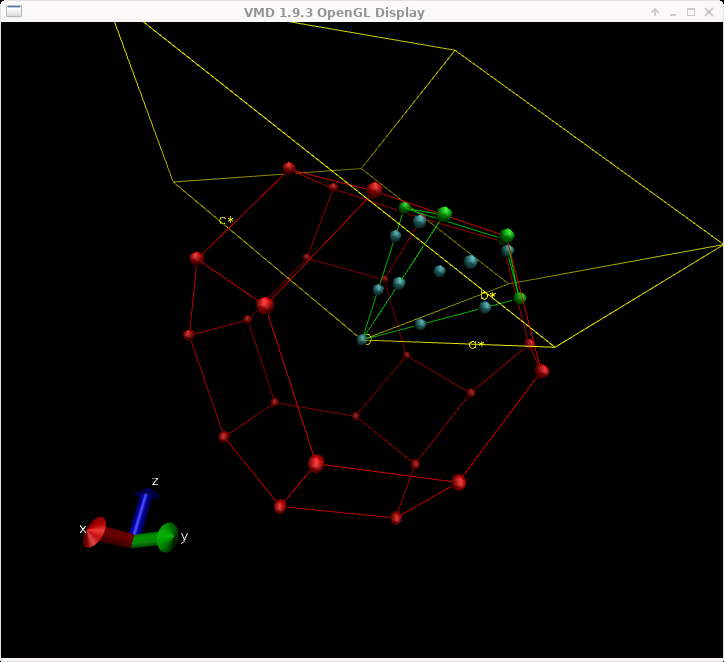
Kpoints can be reduced to this zone
$ c2x --sym --vmd_recip -M=5,5,5 --ibz -r fcc.cell fcc.vmd
A strange cubic cell
%block LATTICE_CART
1 0 0
2 1 0
3 2 1
%endblock LATTICE_CART
is a primitive cell of the cubic lattice, albeit not the conventional one. The Brillouin zone is defined by the lattice, not by the choice of primitive cell, so it is still a cube.
$ c2x --fbz --vmd_recip cubic.cell cubic.vmd

Other Options
The output options --verts
and --verts_frac in place of --vmd_recip
produce a bare list of the vertices of the zone calculated.
Miscellaneous
The volume of the Brillouin Zone is the volume of the reciprocal space unit cell is the reciprocal of the volume of the real space unit cell. The volume of the IBZ is the volume of the BZ divided by the number of symmetry operations in k-space. That is the theory, and c2x should warn if its output disagrees.
The code is full of horrid floating-point comparisons. One may get
different (better) results by adjusting the tolerance with which these
are made, e.g. -e=1e-8. I'd be interested if this is ever
necessary.